Why a buyer visits this page
The buyer has seen a “300g Double PE-Coated” option and is unsure whether the second coating is needed for condensation, wet handling, or the chosen beverage. This page answers that decision before the buyer commits to a material or artwork proof.
Quick answer
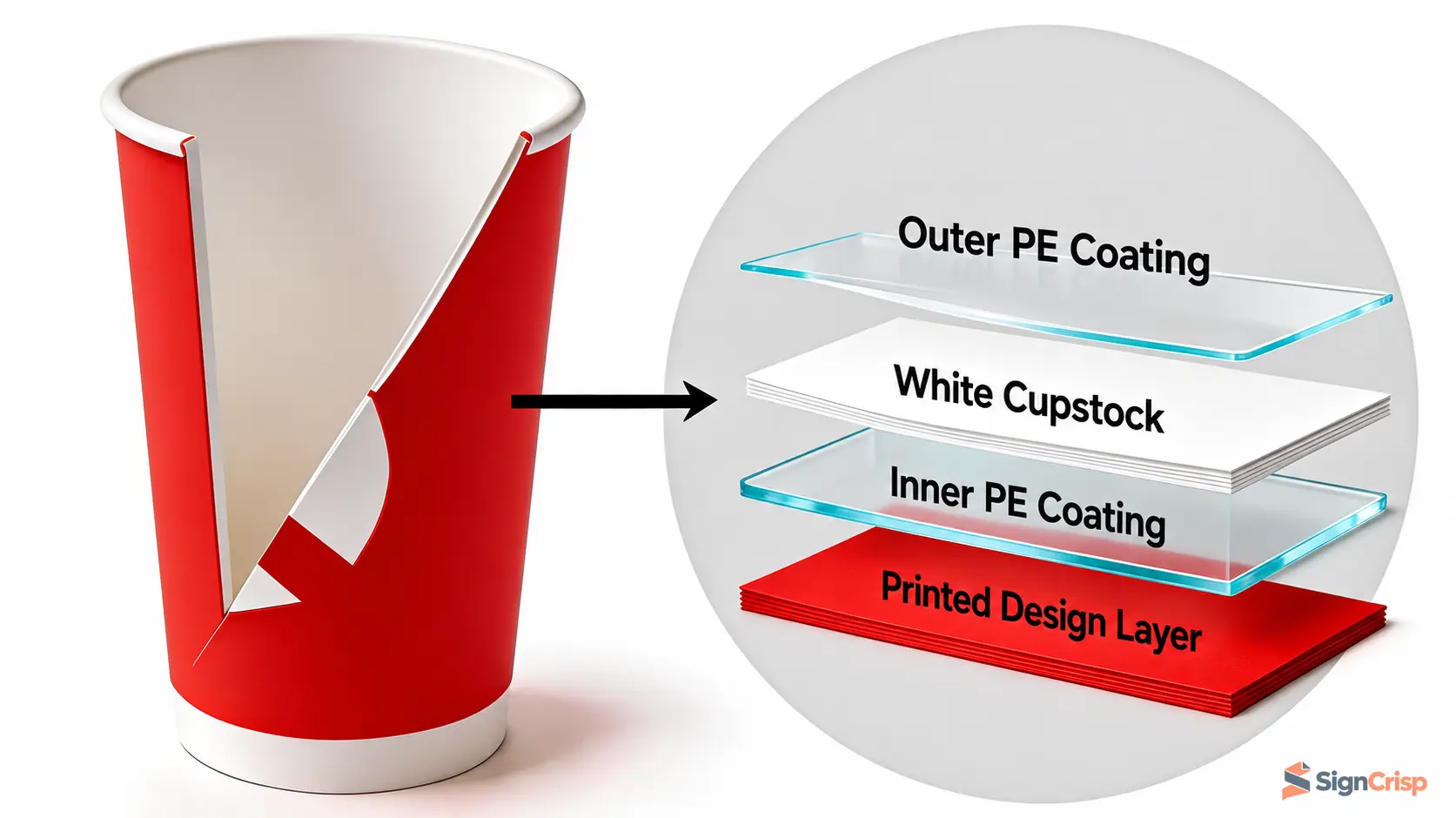
Double PE-coated cupstock, also called 2PE, has a PE layer on both sides of the paperboard. The supplied material note describes 260 gsm base paper + 25 gsm inner PE + 15 gsm outer PE, with a source caliper around 0.48 mm / 18.9 mil.
Verified construction
| Layer | Supplied note |
|---|---|
| Base paper | Approx. 260 gsm |
| Inner PE | Approx. 25 gsm |
| Outer PE | Approx. 15 gsm |
| Source caliper | Approx. 0.48 mm / 18.9 mil |
These are quotation values. The quote does not establish the exact PE grade, coating tolerance, ink system, seam strength, bottom seal, or food-contact documentation. Ask for the current technical sheet before using a safety or performance claim.
When to consider 2PE
An outer PE layer may be useful when the printed cup wall will face more condensation, humid surroundings, or wet handling. Industry terminology commonly separates 1PE and 2PE this way, but the label alone does not guarantee a leak-free or condensation-proof finished cup. Performance depends on the paperboard, coating uniformity, seam, rim, bottom seal, forming, storage, and the intended beverage.
Confirm whether the cup is for hot drinks, cold drinks, or both. Ask for a finished-cup test under the expected temperature, holding time, and ambient humidity.
Printing and finishing
The example quote shows four-color process printing and double-sided artwork. Confirm the printable surface, surface treatment, ink adhesion, drying, and whether white underprint is required. Foil stamping is a separate finishing process; it is not included simply because the stock is double PE-coated.
Order checklist
- Confirm inner and outer PE weights, coating sides, and tolerances.
- Request a formed-cup sample, not only a flat printed sheet.
- Test the seam, rim, and bottom seal for the intended beverage and environment.
- Obtain current finished-cup compliance and ink documents.
FAQ
Why add PE to the outside? It may help the printed wall handle more moisture exposure, but the finished cup must be tested.
Is 2PE required for every hot cup? No. It is a construction choice based on moisture exposure, forming, and the intended application.
Does 0.48 mm describe the exact finished wall thickness? It is an approximate source value. Confirm the measurement method and tolerance with the supplier.
Next step: Request a 2PE formed-cup sample