In this article
Key Takeaways
- Start with function, not finish: perforated film gives graphics plus a view out, frosted film gives privacy plus light, and opaque film gives solid graphics, hours or logos.
- Perforated one-way vision works best when it is brighter outside; at night a bright interior can be seen from a darker street, so it is not guaranteed privacy; 60/40 is an approximate printable-to-open area, not a certified privacy rating.
- Frosted privacy and light depend on the film grade: some films reveal silhouettes close to the glass, so test the specific film by day and by night for clinics or spas.
- Opaque does not mean total blackout: specify a blockout product when blackout is required, and check the finish against the site’s needs before ordering.
- Follow the selected film’s wet or dry installation instructions (for example, ORAJET 3636 specifies dry application only); use approved cleaners, avoid ammonia-based cleaners (ORAFOL), and do not use a razor on coated glass unless permitted.
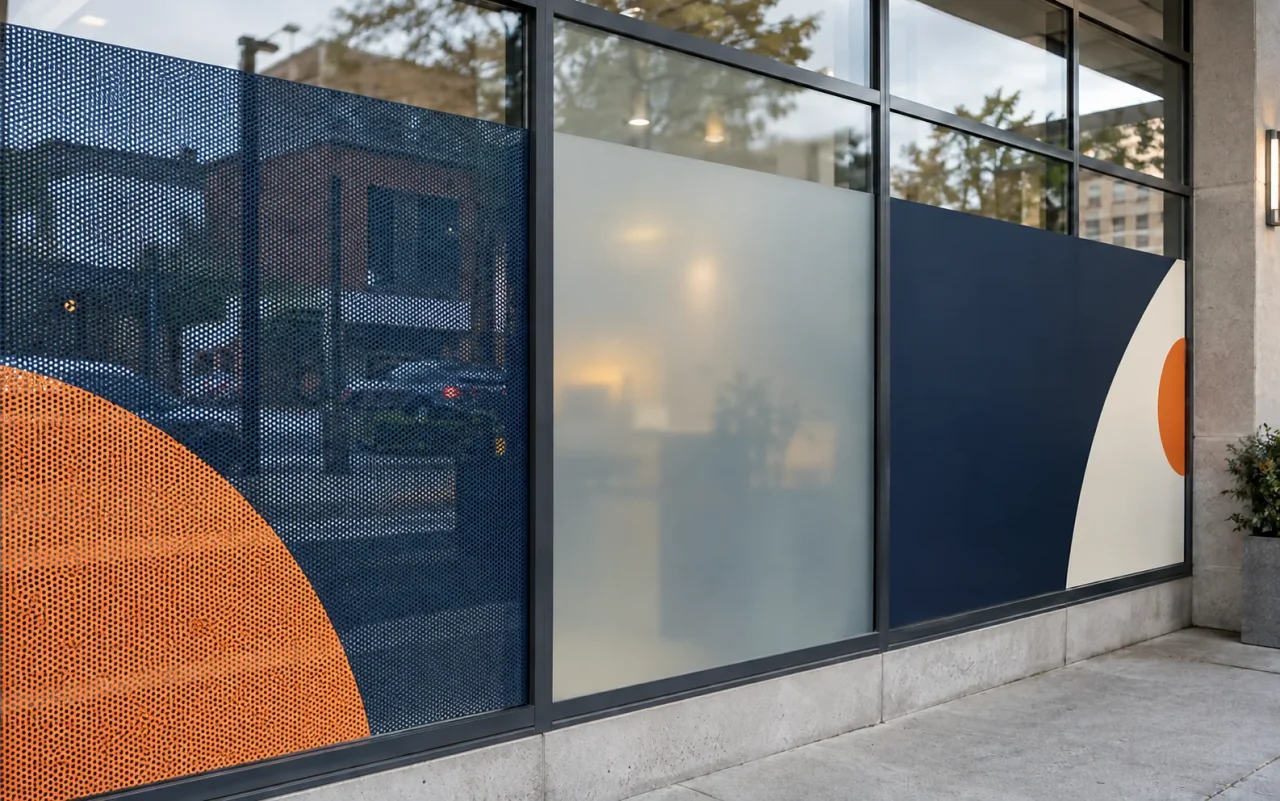
Storefront window graphics can advertise your business, manage views through the glass or create a more private interior. Perforated window vinyl, frosted film and opaque graphics achieve different results. Start with the function you need before choosing the finish.
Quick Answer: Privacy and Visibility
- Perforated One-Way Vision Vinyl displays a graphic while preserving a view through the holes. With conventional film, the effect works best when the outside is brighter than the interior. At night, a brightly lit shop can become visible from a darker street.
- Frosted or Etched-Effect Film diffuses the view and can provide privacy while admitting light. The amount of light transmission and privacy depends on the grade: some films still reveal silhouettes, especially close to the glass. For a clinic, spa or other privacy-sensitive room, select and test the specific film under the actual day-and-night lighting conditions.
- Opaque Graphic Vinyl is useful for store hours, logos and solid printed areas. “Opaque” does not necessarily mean total light-blocking; if blackout is required, specify a blockout product and confirm its performance.
1. The Nighttime Privacy Myth: What Every Buyer Must Know About Perforated Vinyl
Perforated window graphics use a printable face, a dark reverse and open holes to balance the image with a view through the glass. A “60/40” construction commonly means approximately 60% printable material and 40% open area, but ratios and hole sizes vary. The open-area figure is not the same as a certified daylight-transmission or privacy rating. Lighting on both sides of the glass has a major effect.
- During the Day (Outside Brighter): The printed exterior face tends to dominate the view from outside, while people indoors can look through the holes. This reduces visibility into many interiors, but it is not an absolute privacy guarantee at every distance or angle.
- At Night (Interior Lights On): When the interior is brighter than the street, people outside may see through conventional perforated film. If a room needs dependable visual privacy after dark, use a suitable privacy or blockout system and verify the result on site; blinds or another privacy layer may also be appropriate.
2. Storefront Window Graphics: Compare the Three Materials
| Feature | Perforated Window Graphics | Frosted / Etched-Effect Film | Opaque / Blockout Graphics |
|---|---|---|---|
| Daytime Privacy | Often reduces the view inside when the exterior is brighter; not a complete privacy guarantee. | Depends on the frosting grade, lighting and distance from the glass. | Obscures the view through covered areas; specify blockout if light exclusion matters. |
| Nighttime Privacy | Conventional grades can allow views inside when interior lighting is brighter. | Can provide privacy day and night, but grade selection and silhouette testing still matter. | A suitable blockout construction provides the strongest light and view barrier where applied. |
| Daylight | Depends on the full film/glass construction, not just the printed-area ratio. | Product-specific: light and heavy frost grades have different transmission. | Opaque and true blockout products have different light-transmission performance. |
| Mounting Surface | Common printed grades are exterior-applied; some systems are designed for interior mounting. | Use the product approved for the intended interior or exterior surface. | Specify the right adhesive, print orientation and glazing compatibility for the surface. |
| Installation Method | Often dry application; follow the selected grade’s instructions. | Wet application is possible only for compatible films and adhesives. | Wet or dry according to the product; do not wet-apply air-release or other dry-only constructions. |
3. Wet or Dry Installation: Follow the Selected Film’s Instructions
Some frosted and solid films can be wet-applied to suitable glass, which allows positioning before the adhesive bonds. Other films require dry application, including many air-release products and common perforated grades. Check the exact film and adhesive instructions first rather than assuming that one soap recipe works for every window graphic.
- Clean and Check the Glass: Remove dirt and residue using cleaners approved by both the glass/coating supplier and the film manufacturer. ORAFOL advises against ammonia-based glass cleaners for its vinyl applications. Do not use a razor on coated or treated glass unless the glass manufacturer permits it. The surface must be sound and compatible with the chosen film.
- Use an Approved Application Fluid: If wet application is permitted, use the fluid or dilution specified for that film. Detergents containing additives can affect adhesion, and excess soap can delay bonding. There is no universal 500 ml bottle recipe that is appropriate for every adhesive.
- Position and Squeegee as Directed: For an approved wet application, apply the specified fluid, position the film and use the recommended squeegee technique to move fluid and air toward the edges. Allow the stated drying time before removing application tape, cleaning or exposing the edges to water. Large panes and complicated graphics can justify using an experienced installer.
- Perforated Film: Check the Dry-Application Requirement. Common products such as ORAJET 3636 specify dry application only. Follow the selected product’s instructions for surface preparation, edge sealing and any required laminate. An installation method for a different window film is not a safe substitute.
Need custom window decals or frosted door logos? Explore options on our Custom Signs & Graphics Page or email your glass measurements to hello@signcrisp.com.
Technical References
- Contra Vision: One Way Window Film That Works At Night
- Contra Vision Privacy Window Film
- ORAFOL Americas Support: General Application
- ORAJET 3636 Window Graphics Film